> ## Documentation Index
> Fetch the complete documentation index at: https://developer.z-api.io/llms.txt
> Use this file to discover all available pages before exploring further.
# Delete messages
> Delete a sent or received message from a chat
## Overview
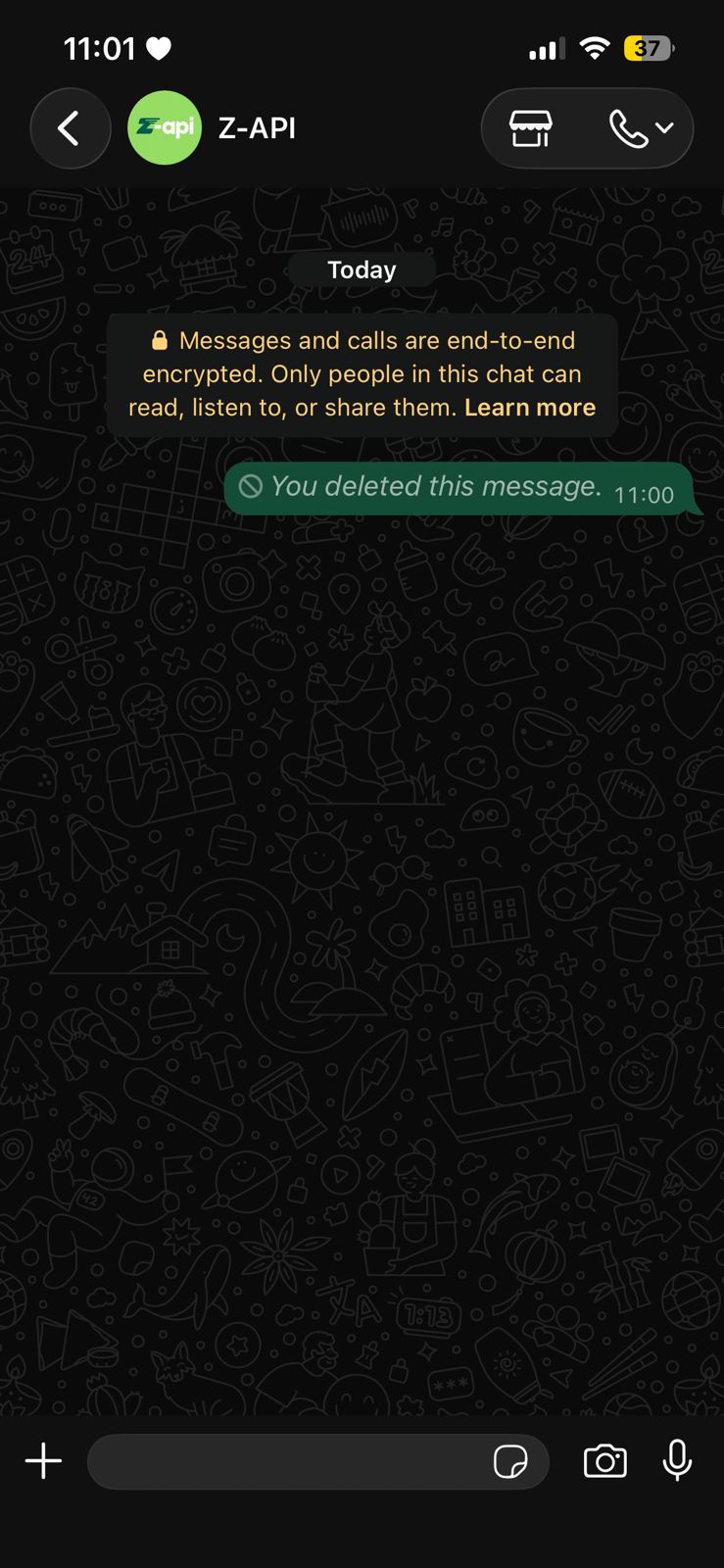
Method used to delete a message from a chat. You can delete both a message you sent and a message sent by a contact. To use this feature you only need the messageId of the message you want to delete.
#### Example on WhatsApp
***
## Attributes
### Header
Your instance ID. Available in the Z-API panel under **Instances**.
Your Z-API instance token.
### Query Parameters
Original message ID
Recipient/sender phone number (or group ID for group messages) in DDI DDD NUMBER format. E.g.: 551199999999
Set to `true` if you sent the message or `false` if it was a received message
## Request Example
### Example URL
```bash theme={"theme":{"light":"github-light","dark":"poimandres"}}
DELETE https://api.z-api.io/instances/{instanceId}/token/{instanceToken}/messages?messageId=123&phone=5511999998888&owner=true
```
***
## Response
### 204
No content
```json theme={"theme":{"light":"github-light","dark":"poimandres"}}
{}
```
### 405
Make sure you are correctly sending the method specification, that is, verify that you sent DELETE as specified at the beginning of this topic.
### 415
If you receive a 415 error, make sure to add the "Content-Type" header to your request, which in most cases is "application/json".