Responder lista de opções
curl --request POST \
--url https://api.z-api.io/instances/{instanceId}/token/{token}/reply-option-list \
--header 'Client-Token: <api-key>' \
--header 'Content-Type: application/json' \
--data '
{
"phone": "<string>",
"messageId": "<string>",
"responseOptionId": "<string>"
}
'import requests
url = "https://api.z-api.io/instances/{instanceId}/token/{token}/reply-option-list"
payload = {
"phone": "<string>",
"messageId": "<string>",
"responseOptionId": "<string>"
}
headers = {
"Client-Token": "<api-key>",
"Content-Type": "application/json"
}
response = requests.post(url, json=payload, headers=headers)
print(response.text)const options = {
method: 'POST',
headers: {'Client-Token': '<api-key>', 'Content-Type': 'application/json'},
body: JSON.stringify({phone: '<string>', messageId: '<string>', responseOptionId: '<string>'})
};
fetch('https://api.z-api.io/instances/{instanceId}/token/{token}/reply-option-list', options)
.then(res => res.json())
.then(res => console.log(res))
.catch(err => console.error(err));<?php
$curl = curl_init();
curl_setopt_array($curl, [
CURLOPT_URL => "https://api.z-api.io/instances/{instanceId}/token/{token}/reply-option-list",
CURLOPT_RETURNTRANSFER => true,
CURLOPT_ENCODING => "",
CURLOPT_MAXREDIRS => 10,
CURLOPT_TIMEOUT => 30,
CURLOPT_HTTP_VERSION => CURL_HTTP_VERSION_1_1,
CURLOPT_CUSTOMREQUEST => "POST",
CURLOPT_POSTFIELDS => json_encode([
'phone' => '<string>',
'messageId' => '<string>',
'responseOptionId' => '<string>'
]),
CURLOPT_HTTPHEADER => [
"Client-Token: <api-key>",
"Content-Type: application/json"
],
]);
$response = curl_exec($curl);
$err = curl_error($curl);
curl_close($curl);
if ($err) {
echo "cURL Error #:" . $err;
} else {
echo $response;
}package main
import (
"fmt"
"strings"
"net/http"
"io"
)
func main() {
url := "https://api.z-api.io/instances/{instanceId}/token/{token}/reply-option-list"
payload := strings.NewReader("{\n \"phone\": \"<string>\",\n \"messageId\": \"<string>\",\n \"responseOptionId\": \"<string>\"\n}")
req, _ := http.NewRequest("POST", url, payload)
req.Header.Add("Client-Token", "<api-key>")
req.Header.Add("Content-Type", "application/json")
res, _ := http.DefaultClient.Do(req)
defer res.Body.Close()
body, _ := io.ReadAll(res.Body)
fmt.Println(string(body))
}HttpResponse<String> response = Unirest.post("https://api.z-api.io/instances/{instanceId}/token/{token}/reply-option-list")
.header("Client-Token", "<api-key>")
.header("Content-Type", "application/json")
.body("{\n \"phone\": \"<string>\",\n \"messageId\": \"<string>\",\n \"responseOptionId\": \"<string>\"\n}")
.asString();require 'uri'
require 'net/http'
url = URI("https://api.z-api.io/instances/{instanceId}/token/{token}/reply-option-list")
http = Net::HTTP.new(url.host, url.port)
http.use_ssl = true
request = Net::HTTP::Post.new(url)
request["Client-Token"] = '<api-key>'
request["Content-Type"] = 'application/json'
request.body = "{\n \"phone\": \"<string>\",\n \"messageId\": \"<string>\",\n \"responseOptionId\": \"<string>\"\n}"
response = http.request(request)
puts response.read_body{
"zaapId": "<string>",
"messageId": "<string>",
"id": "<string>"
}Messages
Responder lista de opções
Responde uma opção de lista de opções como se o usuário tivesse tocado nela
POST
/
instances
/
{instanceId}
/
token
/
{token}
/
reply-option-list
Responder lista de opções
curl --request POST \
--url https://api.z-api.io/instances/{instanceId}/token/{token}/reply-option-list \
--header 'Client-Token: <api-key>' \
--header 'Content-Type: application/json' \
--data '
{
"phone": "<string>",
"messageId": "<string>",
"responseOptionId": "<string>"
}
'import requests
url = "https://api.z-api.io/instances/{instanceId}/token/{token}/reply-option-list"
payload = {
"phone": "<string>",
"messageId": "<string>",
"responseOptionId": "<string>"
}
headers = {
"Client-Token": "<api-key>",
"Content-Type": "application/json"
}
response = requests.post(url, json=payload, headers=headers)
print(response.text)const options = {
method: 'POST',
headers: {'Client-Token': '<api-key>', 'Content-Type': 'application/json'},
body: JSON.stringify({phone: '<string>', messageId: '<string>', responseOptionId: '<string>'})
};
fetch('https://api.z-api.io/instances/{instanceId}/token/{token}/reply-option-list', options)
.then(res => res.json())
.then(res => console.log(res))
.catch(err => console.error(err));<?php
$curl = curl_init();
curl_setopt_array($curl, [
CURLOPT_URL => "https://api.z-api.io/instances/{instanceId}/token/{token}/reply-option-list",
CURLOPT_RETURNTRANSFER => true,
CURLOPT_ENCODING => "",
CURLOPT_MAXREDIRS => 10,
CURLOPT_TIMEOUT => 30,
CURLOPT_HTTP_VERSION => CURL_HTTP_VERSION_1_1,
CURLOPT_CUSTOMREQUEST => "POST",
CURLOPT_POSTFIELDS => json_encode([
'phone' => '<string>',
'messageId' => '<string>',
'responseOptionId' => '<string>'
]),
CURLOPT_HTTPHEADER => [
"Client-Token: <api-key>",
"Content-Type: application/json"
],
]);
$response = curl_exec($curl);
$err = curl_error($curl);
curl_close($curl);
if ($err) {
echo "cURL Error #:" . $err;
} else {
echo $response;
}package main
import (
"fmt"
"strings"
"net/http"
"io"
)
func main() {
url := "https://api.z-api.io/instances/{instanceId}/token/{token}/reply-option-list"
payload := strings.NewReader("{\n \"phone\": \"<string>\",\n \"messageId\": \"<string>\",\n \"responseOptionId\": \"<string>\"\n}")
req, _ := http.NewRequest("POST", url, payload)
req.Header.Add("Client-Token", "<api-key>")
req.Header.Add("Content-Type", "application/json")
res, _ := http.DefaultClient.Do(req)
defer res.Body.Close()
body, _ := io.ReadAll(res.Body)
fmt.Println(string(body))
}HttpResponse<String> response = Unirest.post("https://api.z-api.io/instances/{instanceId}/token/{token}/reply-option-list")
.header("Client-Token", "<api-key>")
.header("Content-Type", "application/json")
.body("{\n \"phone\": \"<string>\",\n \"messageId\": \"<string>\",\n \"responseOptionId\": \"<string>\"\n}")
.asString();require 'uri'
require 'net/http'
url = URI("https://api.z-api.io/instances/{instanceId}/token/{token}/reply-option-list")
http = Net::HTTP.new(url.host, url.port)
http.use_ssl = true
request = Net::HTTP::Post.new(url)
request["Client-Token"] = '<api-key>'
request["Content-Type"] = 'application/json'
request.body = "{\n \"phone\": \"<string>\",\n \"messageId\": \"<string>\",\n \"responseOptionId\": \"<string>\"\n}"
response = http.request(request)
puts response.read_body{
"zaapId": "<string>",
"messageId": "<string>",
"id": "<string>"
}Conceituação
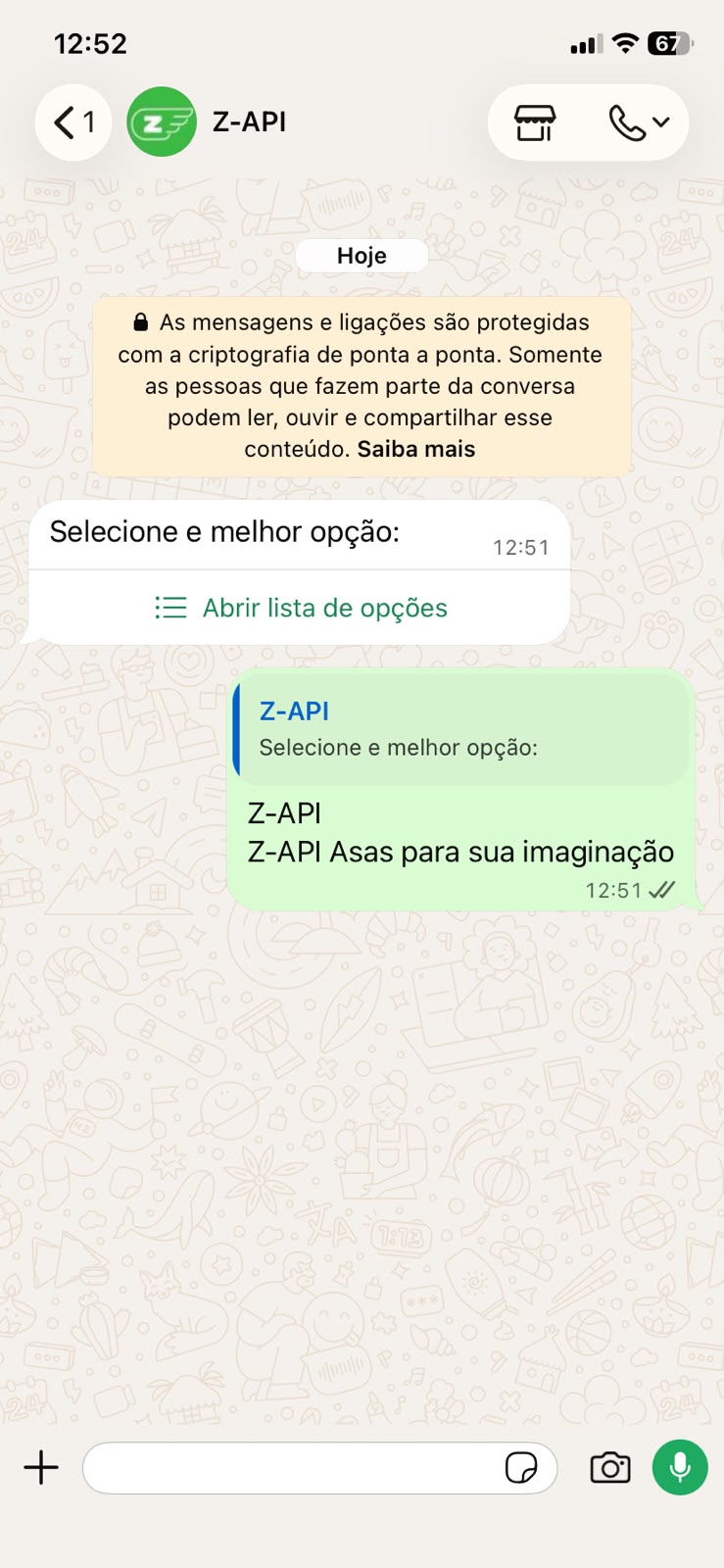
Este endpoint permite responder uma lista de opções, simulando o toque do usuário em uma das opções enviadas anteriormente via send-option-list.A lista precisa ter sido enviada ou recebida previamente. O ID da opção deve ser o mesmo
id definido para essa opção no momento do envio da lista ou no webhook recebido.Exemplo no WhatsApp
Atributos
string
obrigatório
ID da sua instância. Disponível no painel Z-API em Instâncias.
string
obrigatório
Token da sua instância Z-API.
Obrigatórios
string
obrigatório
Telefone (ou ID do grupo) no formato DDI DDD NÚMERO. Ex: 551199999999
string
obrigatório
ID da mensagem de lista de opções que está sendo respondida.
string
obrigatório
ID da opção escolhida. Deve ser o mesmo
id definido na lista ao enviá-la.Request Body
{
"phone": "5511999999999",
"messageId": "3EB0C767D82B0A6E9F5F",
"responseOptionId": "1"
}
Response
200
string
id no z-api
string
id no whatsapp
string
Adicionado para compatibilidade com zapier, ele tem o mesmo valor do messageId
{
"zaapId": "3999984263738042930CD6ECDE9VDWSA",
"messageId": "D241XXXX732339502B68",
"id": "D241XXXX732339502B68"
}
400
Verifique se o body da requisição foi enviado e se os campos obrigatórios (phone, messageId e responseOptionId) estão preenchidos.